InterVarsity Alumnus Troy Anderson “Speaks Up” for Girls in Bangladesh
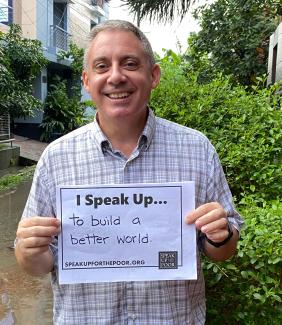
God is using Troy Anderson to make a difference in the lives of vulnerable women and girls around the world.
We sat down with him on the InterVarsity World Changers podcast to hear how his experience in InterVarsity ultimately inspired him to start Speak Up for the Poor, an organization that prevents child marriage and other exploitation.
“There’s no child marriage here, Uncle Troy. What are you talking about?” the girls in a small village in Bangladesh tell Troy Anderson, an InterVarsity alumnus and the founder of Speak Up.
Many of the girls Troy works with are only 9, 10, or 11 years old when they first enter Speak Up’s “Girl Empowerment Program,” which works to prevent child marriage, exploitation, and trafficking through education. Most don’t remember what their villages looked like a decade ago. But Troy does.
In Bangladesh alone, roughly 60 to 65 percent of girls are married before the age of 18.
Child marriage can lead to lifelong vulnerability. Young brides often leave school, move into their husband’s family home, and have children early. If the marriage fails, they find themselves with little education and nowhere to turn. Some end up in the commercial sex industry to support themselves.
But a lot of that is changing in the villages served by Speak Up.
“Now it’s normal for girls to stay in school,” Troy said.
‘This is Different’
Troy describes his childhood as “scrambled.” His parents were international teachers, so he grew up in places like Yemen and Syria. From an early age, he saw that the world was vast and full of complex issues and pains.
Although he was raised in a Christian family, his faith was wavering by the time he started college at the University of Puget Sound in Washington. When someone invited him to an InterVarsity Bible study during his sophomore year, he was skeptical. He wasn’t interested in joining a Christian group that didn’t apply their faith to real-world issues.
The campus staff minister at the time, Catherine, told him about InterVarsity’s urban summer projects, where students serve in cities like Seattle and Tacoma. The group also studied the book of Amos — a prophet who spoke directly about social injustice.
“I thought, Oh, this is different than what I perceived most Christian groups as,” Troy said. He was used to Christians who talked a lot about theology and being nice but didn’t engage with the poor. “This is a real model of the faith that I can grab onto.”
Troy became deeply involved with InterVarsity until he graduated. Then, he came on staff!
Facing Evil in the World
After seven years with InterVarsity, Troy worked with Servant Partners, a Christian urban ministry born out of InterVarsity on the West Coast. He later enrolled in law school, hoping to use his degree to continue serving those on the margins. Around that same time, he began learning more about the commercial sex industry and forced prostitution around the world.
One day while he was reading Proverbs 31, a couple of verses stood out to him:
Speak up for those who cannot speak for themselves,
for the rights of all who are destitute.
Speak up and judge fairly;
defend the rights of the poor and needy.
Proverbs 31:8-9
That's what I want to do, he thought.
The summer after his first year of law school, he traveled to northern Thailand, where he worked with several organizations addressing human trafficking.
However, he soon realized his law degree wasn’t especially useful in that context because he didn’t speak the local language. Instead, he was asked to help in an unusual way: as a white American man, he could be mistaken for a sex tourist. So, Troy was sent to go undercover in brothels across the region, where he saw the horrors of human trafficking firsthand.
“I remember going home, and I would physically vomit because it was so, so profoundly evil,” he said.
Imagining a Different Future
Troy’s grief led him to start an organization that prevents this kind of evil from harming girls and women.
Speak Up offers education programs in 40 villages and slum communities across the Khulna region in western Bangladesh, serving around 2,500 girls from extremely poor backgrounds. They run after-school tutoring programs, job training, a stipend program to help girls stay in school, and even operate dormitories for those in particularly difficult circumstances.
“By the time [these girls] are 13 or 14, they start facing these pressures to get married,” Troy explained. “A girl who joins our program in the fifth grade has probably about a 60 to 70 percent chance of finishing higher education.”
When girls stay in school, they begin imagining different futures. “They're realizing, ‘I do want to be a nurse or a teacher,” Troy said. “They start owning it.”
Several graduates of Speak Up’s programs have even gone on to serve as employees and social workers within the organization.
“Who could be a better social worker?” he said. “They’re a great example to the whole village.”
Bangladesh has numerous other communities facing similar challenges, but Troy believes that supporting girls’ education could transform entire regions over time.
“If you recreate that in tens of millions of young girls, one day you're going to have an army of people that are empowered,” he said.
Go Love People
Troy sees sex trafficking as the extreme outcome of a broader problem: ”It’s the ultimate manifestation of our worst impulse to objectify a girl. It’s just taking it to its evil extreme.”
The problems that allow exploitation to continue range from pornography and lust to the everyday ways women are devalued. Troy’s time on InterVarsity staff gave him the chance to walk alongside young men struggling with these issues. And while he believes it's good to have spaces for these conversations within Christian community, he also sees the risk of focusing only on self-protection. One of the key lessons he learned through InterVarsity — and hopes others embrace — is to take faith seriously by moving beyond self-protection and towards confronting injustice in the world.
“Let's go love people instead of just protecting ourselves from the world,” he said.
Find the rest of Troy’s story here. And join us in praying for world changers like him as they help vulnerable people around the world imagine better futures.

Related Content

Tatiana Ordoñez is a business owner partnering with artisans in Colombia. After meeting InterVarsity in college and learning about an NGO that works to preserve cultural crafts in Türkiye, she started Zuahaza, a sustainable textile company.
Related Content

Through Redeeming Babel, Curtis creates resources like podcasts, courses, and more to help believers navigate a chaotic and anxiety-ridden world.